


Beyond the Matches: How the 2026 FIFA World Cup Could Transform Houston for Generations
By Taiwan Mixon
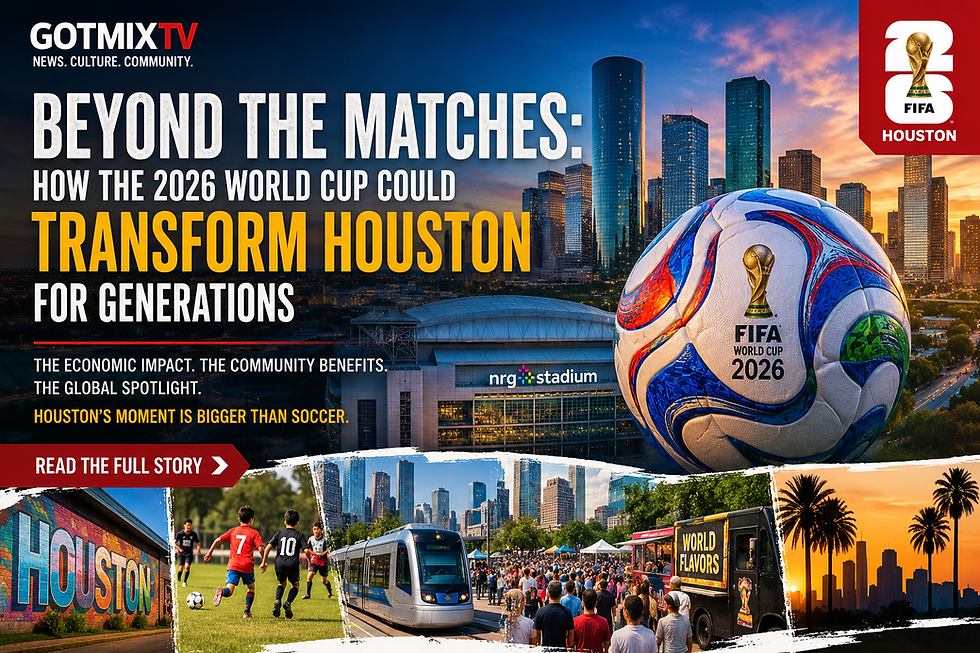
When most people think about the FIFA World Cup coming to Houston in 2026, they picture packed stadiums, passionate fans waving national flags, and some of the world's greatest soccer players competing on the sport's biggest stage. While those images will undoubtedly become reality, the true story of Houston's World Cup experience may not be found inside the stadium at all.
Instead, the most significant impact could be what happens after the final whistle blows.
Houston is one of 16 host cities selected for the 2026 FIFA World Cup, which will be jointly hosted by the United States, Canada, and Mexico. The city will welcome hundreds of thousands of visitors from around the world, placing Houston in an international spotlight unlike anything it has experienced since hosting major events such as the Super Bowl.
Yet the World Cup offers something different. Unlike a one-day championship game, the tournament spans weeks and brings visitors from dozens of countries, creating opportunities that can reshape Houston's economy, infrastructure, tourism industry, and global reputation for decades.
Houston's Global Introduction
Houston is already America's fourth-largest city, but many international visitors know little about it beyond its connection to the energy industry and NASA.
The World Cup provides Houston with a rare opportunity to introduce itself to billions of viewers worldwide.
Television broadcasts will showcase Houston's skyline, diverse neighborhoods, restaurants, museums, parks, and cultural landmarks. International visitors will experience a city that is one of the most culturally diverse places on Earth, where more than 145 languages are spoken.
For many visitors, Houston will become their first impression of Texas.
That exposure has lasting value. Cities that successfully host major international events often experience increased tourism years after the event concludes because visitors return with family and friends after discovering a destination they never previously considered.
Small Businesses Could Be the Biggest Winners
Much attention has focused on hotels and large corporations preparing for the World Cup. However, some of the biggest beneficiaries may be Houston's small business owners.
Local restaurants, food trucks, transportation providers, retail shops, photographers, event planners, tour operators, and entrepreneurs could see unprecedented demand.
Houston's international food scene may become one of its greatest assets during the tournament. Visitors from Europe, South America, Africa, Asia, and the Middle East will likely seek authentic cultural experiences. Houston's diverse culinary landscape gives it a unique advantage over many host cities.
Businesses that prepare now by improving online visibility, multilingual customer service, and international payment options could position themselves for significant growth.
A New Era for Soccer in Houston
The World Cup may also accelerate soccer's growth across Greater Houston.
Youth participation in soccer has steadily increased for years, but hosting World Cup matches could inspire an entirely new generation of players.
Young athletes who watch international stars compete in Houston may develop aspirations that previous generations never imagined. Local clubs, academies, schools, and recreational leagues could see increased participation long after the tournament ends.
The impact could be especially significant in Houston's immigrant communities, where soccer already plays a major role in cultural identity.
For many children, seeing their country's national team compete in their hometown could create lifelong memories and stronger connections to both their heritage and their city.
Transportation: Houston's Biggest Test
While excitement surrounding the World Cup continues to grow, transportation remains one of Houston's greatest challenges.
Visitors from around the world are accustomed to extensive public transportation systems. Houston's ability to move large crowds efficiently will be closely scrutinized.
The tournament presents an opportunity for city leaders, transportation agencies, and private partners to demonstrate improvements in mobility, traffic management, and visitor accessibility.
Success could strengthen Houston's reputation as a city capable of hosting future international events.
Failure could become one of the tournament's lasting storylines.
The World Cup will serve as a real-world test of Houston's infrastructure on a global stage.
The Hidden Economic Impact
Most discussions surrounding the World Cup focus on visitor spending during the tournament itself. However, economists often point to secondary benefits that emerge years later.
International companies considering expansion into the United States may view Houston more favorably after seeing the city successfully host a massive global event.
Convention organizers may become more likely to select Houston for future conferences.
Investors may discover opportunities they previously overlooked.
Universities, healthcare institutions, technology firms, and tourism organizations could all benefit from increased international exposure.
These long-term gains are difficult to measure but often become some of the most valuable outcomes of hosting major events.
Houston's Opportunity to Define Its Identity
Perhaps the most overlooked aspect of the World Cup is the opportunity for Houston to define its own narrative.
For decades, the city has often been viewed primarily through the lens of oil, gas, and space exploration.
The World Cup offers a chance to showcase a different side of Houston: a multicultural, globally connected city filled with innovation, entrepreneurship, arts, sports, and opportunity.
The world will be watching.
The question is not whether Houston will host World Cup matches.
The question is what story Houston wants to tell while the world is paying attention.
If city leaders, businesses, and residents seize the moment, the 2026 FIFA World Cup may ultimately be remembered not for the matches played in Houston—but for how it transformed the city long after the tournament ended.


Comments